
Pharmaceutical Shelf-Life Determination

Stuart R. Gallant, MD, PhD

Pharmaceutical shelf-life determination affects patient safety by assuring that the strength, quality, purity, and potency of an investigational or commercial drug are preserved until the moment that the drug is delivered to the patient.  At the same time, storage condition affects the clinical plan by dictating how the drug will be shipped and handled prior to administration.  Further, storage condition and shelf life factor into the marketing plan by dictating how the drug will be maintained and inventoried in the supply chain.

Today’s PharmaTopo post addresses:  1) planning and execution of pre-clinical and clinical stability studies to support shelf-life determination and 2) tracking and trending data to provide ongoing oversight of clinical supplies and ensure adequate inventory to support clinical commitments.

Overview and Terminology

Stability studies monitor the stability of drug substance and drug product.  Drug substance is commonly stored in:

  • Powders:  Contact layer of low-density polyethylene (LDPE); outer bag of heat sealable polyethylene and aluminum foil.
  • Liquids:  Stainless steel or a multilayer bag with an ethyl vinyl acetate (EVA) contact layer.

Because drug substance bulks are significantly larger than the small samples used in stability testing, thought should be devoted to surface area affects to ensure that accurate modeling is achieved.  For drug product, individual examples of the drug product units are held as stability samples.  Important terminology includes:

  • Stability indicated assays:  Assays, often HPLC methods, which monitor the assay, purity, and impurity levels of the drug substance and drug product.
  • Product related impurities:  Impurities generated during the manufacturing process which do not change in level during storage.
  • Degradants:  Impurities which increase during storage—the levels of degradants are tracked during stability studies.
  • Stress studies:  Studies in which samples are exposed to higher levels of moisture, oxygen, pH, temperature, and light are important to documenting the stability indicating nature of stability methods.

The ICH stability pull points are:

The ICH storage conditions are:

Drug Substance or Product Storage ConditionStudies (Condition, Minimum Duration)
Room TemperatureLong Term (25°C/60% RH, 12 months) Intermediate (30°C/65% RH, 6 months) Accelerated (40°C/75% RH, 6 months)
RefrigeratedLong Term (5°C/Ambient RH, 12 months) Accelerated (25°C/60% RH, 6 months)
FrozenLong Term (-20°C/Ambient RH, 12 months)

Significant changes for accelerated conditions include:  5% potency change, failure to meet specification for any degradant, failure to meet specification for appearance or physical properties, pH out of specification, or dissolution failing to meet specification.

Stability Data

Stability data is the end result of numerous processes, each which add some degree of variability to the data:

  • Raw Materials:  Formulation agents and packaging components each have their own lot to lot variability; there may be more substantial variability if multiple vendors with separate manufacturing processes are used for individual raw material components.
  • Active Ingredient and Drug Product:  The drug substance can vary in quality.  Properties such as particle size distribution and polymorph can contribute to drug product stability.  Drug product manufacturing can add significant variability—for instance, gradients in lyophilizer temperature may expose freeze dried drug products to different freezing profiles.
  • Drug Product Conditions and Container Integrity:  Stability chambers are designed to provide uniform storage conditions, but individual drug product packages may possess greater or lesser seal integrity.  Desiccants lots may vary in efficacy.
  • Testing:  In some cases, the window for testing a given pull point can be quite wide, yet for example, the “6 mo” point will be labeled as such, even if it was pulled early or late.  Sample preparation and hold prior to testing can vary, as can operator technique, not to mention variability of the testing methods themselves.

Over product lifecycle, the lot-to-lot variability of drug substance and drug product should decrease, but particularly early on, the variability can be large enough to prevent use of all the data together.  In shelf-life determination, application of statistical testing to the individual lots allows determination if the batch data can be pooled.  The steps are:

  1. Fit data with a linear (slope, intercept) models:  The example data used below is from Chow and Shao [1].  Each batch of data is fit separately; Chow and Shao provide potency data for 24 batches, so there are 24 slopes and 24 intercepts that result from fitting.
  2. Apply statistical criteria to fitted slope and intercept values:  The goal is to see if the data can be pooled.  Typically, for clinical lots, the data will be analyzed individually, rather than being pooled because the number of lots is few and the sources of variability are larger, compared to commercial lots.  Using analysis of covariance (ANCOVA), the slope and intercept values are compared; a p-value of 0.25 must be met or exceeded for both the slope and the intercept for the data to be pooled; otherwise, each batch is treated separately in determination of shelf life.  The shortest shelf life becomes the shelf life of the product [2].

An example of this type of analysis using the data from Chow and Shao is provided below.  24 lots of data were fit for slope and intercept, and the statistical criteria were not met, so the lots had to be treated individually.  The individual shelf lives obtained for the 24 batches had the following summary statistics:

A histogram of the 24 individual shelf lives reveals a diverse set of product stabilities for the individual lots:

Lot 21 had the lowest shelf life (12 months); the Lot 21 data (dots), the linear fit to the data (solid black line), the lower 95% confidence interval for the mean regression line (dashed line), and shelf-life marker line (solid red line) are shown in the graph below:

Tips

Here are a few tips that are worth considering as the project team plans stability studies:

  • Later points are “cheap”:  In the world of clinical development, funding is uncertain.  Using 3-year-old drug substance to manufacture drug product may seem unlikely when a project starts, but if raising money becomes difficult later in a program, the team may want to use 5-year-old drug substance because the capital is not available to run another manufacturing campaign.  Always hold enough stability retains to take a stability study out to at least 5 years, if not longer.  Only terminate the study when the samples no longer meet the acceptance criteria of the study.
  • Pilot studies reduce risk:  As soon as development team believes that representative drug substance and drug product can be manufactured, initiate non-GMP stability studies of the drug substance and drug product.  These studies will front run the GMP studies allowing the team to anticipate problems in the GMP studies before they appear.
  • Backups are a great thing:  A backup formulation helps you reduce risk from the primary formulation if the primary formulation has problems.  Similarly, a backup storage condition (for example, refrigerated when room temperature is the primary storage condition) helps control risk.  Keep taking data on the backup formulation and backup storage condition as long as practically possible.  It is even possible to start a clinical study with a conservative storage condition (for example refrigerated) and relax it later in the study when stability data indicates the more permissive condition is acceptable.
  • Expiry dating:  Labeling drug product with expiry is required in the EU, Canada, Australia, and pretty much everywhere except for the US.  The US accepts that the sponsor with track stability, so no expiry date is required for US clinical studies.  You will need to remind your clinical repository which drug product packages are destined for which regions, so that the repository is clear on the labeling requirements as they label product for distribution.

Conclusions

Shelf-life determination, based on the principles outlined by the ICH, brings together methodical laboratory experiments and rigorous statistical analysis.  Once a shelf life has been established, the project team can have confidence that the most advantageous presentation of the product (in terms of self-life and storage temperature) has been established.  The team can go forward planning manufacturing campaigns to feed the distribution network with assurance of product integrity from manufacturing floor to the moment the patient receives a dose.

[1] Chow, S.C. and Shao J.  “Estimating drug shelf-life with random batches,” Biometrics, 47, 1071-1079 (1991).

[2] ICH Harmonized Tripartite Guideline, Evaluation for Stability Data, Q1E (2003).

Disclaimer: This post is reprinted from PharmaTopoTM.   PharmaTopoTM provides commentary on topics related to drugs.  The content on this website does not constitute technical, medical, legal, or financial advice.  Consult an appropriately skilled professional, such as an engineer, doctor, lawyer, or investment counselor, prior to undertaking any action related to the topics discussed on PharmaTopo.com.

Selecting an Analytical Laboratory

Stuart R. Gallant, MD, PhD

Analytical testing is required to verify the identity, strength, quality, purity, and potency of investigational and commercial products.  The precise set of tests, as set out in the release specifications [1], is tailored to the type of product, manufacturing process, route of administration, and other factors.  Once the release specifications have been set, a pharmaceutical project team must find an analytical laboratory to execute the testing and report the results.  Today’s post discusses the process of selecting and working with an analytical laboratory.

Laboratory Location and Relationship

As you think about project fit, there are a number of factors to consider; the first is location:

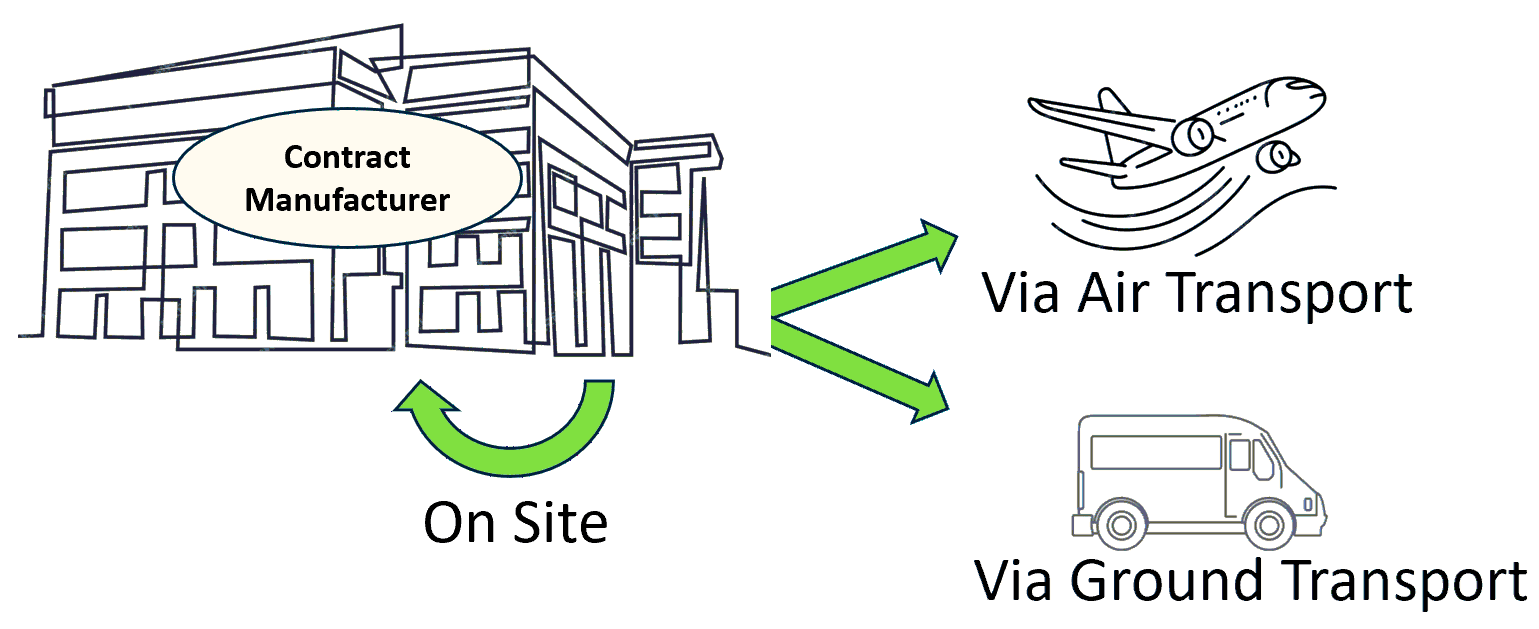
Is the analytical laboratory on-site or remote from the manufacturing facility?  Remote sites require additional management effort and delay, as well as risk of sample loss.  That might make you want to say, “I want to go with the on-site lab,” but the question is more complex.  Other factors include:

  • Expertise:  The client wants to have experts who know their product molecule intimately.  That type of knowledge is amassed over the life of a project.  One recent trend is using a single off-site laboratory for both API and DP release, stability testing, and supplementary characterization.  This approach streamlines testing and ensures consistency within the drug substance and drug product reporting, enhancing the quality of regulatory filings and updates.
  • Integration with the Manufacturing Team:  If you choose an on-site lab integrated with your manufacturer, there will be one project team.  If you choose a separate lab, you may have two separate project teams with the sponsor managing communication between them.  That could be a good or bad thing, depending on how hands-on you as the sponsor are.
  • Contractual Relationships:  If you opt for the on-site lab, you may have less ability to negotiate the time and cost of analytical work.  In terms of timing, your project will go in a queue with all the other projects at your contract manufacturer, possibly leading to delays.  In terms of cost, there is the core cost of release and stability testing, but it can be important to consider other costs, as well.  Will there be additional side projects that generate change orders, and how much will that work cost?

An example of an offsite laboratory that can offer significant advantages is Portrett Pharmaceuticals [2].  They specialize in small molecule testing, including method validation, impurity analysis, stability testing, and compendial testing.  They are currently providing a two-week turnaround on stability testing and guaranteed results within 3 weeks of sample receipt for routine testing.

Request for Proposal

Any good contractual relationship starts with a request for proposal, here are some items to consider as you write RFPs:

  • Specifications and Stability Studies:  You will want to include your specifications, at least in summary form, along with plans for stability studies.
  • Project Integration:  If you want the option to sign with a separate lab, ask the CDMO to include a quote for manufacturing only, not analytical.  Then, discuss that option with the manufacturer to be sure they will support that path.
  • Timing and Cost:  You will need timing and cost information for all the options you want to consider.
  • Data:  At the end of a manufacturing campaign or at any significant point (e.g., after a stability pull point), you should receive all the raw analytical data (analytical notebook pages, chromatograms, etc.); this should be without unreasonable copying charges.

After you receive proposals, you will want to perform site visits.  These may be simple walk throughs or they may be quality audits, depending on how much time you have and other factors.  As a minimum, you will want to do a quality audit of the vendors you select (manufacturing and analytical) prior to initiating GMP manufacturing.

GMP Audit

During a quality audit of an analytical laboratory, a written questionnaire is presented to the site, and after the questionnaire is completed, an on-site visit is performed if necessary.  Some areas to emphasize in the audit include:

  • Personnel:  Qualifications of personnel, training of personnel, training records, temporary or subcontracted personnel, EHS training/procedures.  One area of special focus:  project management and lead scientist assignment; can the client expect a degree of ownership from the assigned personnel?
  • Equipment:  Number and types of equipment, maintenance, adequate backup capacity if a stability chamber breaks down, emergency power.  One area special focus:  changeover, cleaning, and maintenance of HPLCs; what procedures are used to maintain the systems in a meticulous state from the solution inlets to the waste outlets.
  • Workflow:  Adequate square footage for personnel to operate, changeover procedures for individual clients, materials control procedures, adequacy of staffing levels and ability to adjust to high workflow periods, sample tracking, return/destruction procedures for redundant samples.
  • Vendors:  Vendor qualification procedures, subcontracting to outside vendors.  One are of special focus:  does the laboratory have the ability to complete all the required assays, and if not, which tests will be sent to subcontractors.
  • Documentation:  GMP document format, document management, data management, change control.
  • Investigations:  How are out of specifications and deviations managed, what is the role of the client in investigations, summary statistics on previous investigations and outcomes.  One area of special focus:  If assays are subcontracted, how does an investigation at a lab outside the primary laboratory differ?  How is the client kept informed in real time?
  • History:  Facility audit history, summary of previous projects (number, type), distribution of projects (US, EU, other markets).
  • Written Responses:  Some facilities offer a previously prepared written questionnaire that addresses major areas of GMP concern.  Because all GMP audits are quite similar, this can save the vendor time, but the analytical lab quality team should be willing to address the questions of individual clients in a timely manner.

As always, it is important to recall the time-cost-quality trade-off—the goals of rapid execution, low cost, and high quality compete with each other.  Particularly, for early clinical work, the issue of timing can be a challenge—small startups often go at the back of the queue at large vendors, so vendor timelines may be less than optimal, and creative solutions to keep the project on time may be required.

Managing the Relationship

As you move forward with your analytical laboratory over the life of the project, you will want to track the stability pull points to ensure data is returned in a timely manner and incorporated in relevant regulatory documents (e.g., the CTD and annual regulatory updates).  At some point you may find that the relationship changes—the laboratory may be acquired or there may be an unreasonable inflation in testing costs if you did not lock in a rate per pull point.  In such circumstances, you may consider a lab-to-lab transfer of your methods to a new vendor.

Conclusions

Analytical laboratories are key vendors, reported in your regulatory filings.  Ideally, they work closely with your project team to develop, transfer, and execute analytical methods, analyze data, and troubleshoot issues in manufacturing and testing.  Picking the right analytical partner will allow your project to meet its quality, time, and cost targets, ensuring patient safety and maximizing the chances of clinical success for your investigational product.

[1] Gallant, S.R.  “Small Molecule and Antibody Release Specifications—Lessons Learned,” PharmaTopo, June 11, 2025.  pharmatopo.com/index.php/2025/06/11/small-molecule-and-antibody-release-specifications-lessons-learned/

[2] PharmaTopo has no financial relationship with Portrett Pharmaceuticals.  Contact Portrett through their website:  www. portrett.com.

Disclaimer:  This post is reprinted from PharmaTopoTM. PharmaTopoTM provides commentary on topics related to drugs.  The content on this website does not constitute technical, medical, legal, or financial advice.  Consult an appropriately skilled professional, such as an engineer, doctor, lawyer, or investment counselor, prior to undertaking any action related to the topics discussed on PharmaTopo.com.

Small Molecule and Antibody Release Specifications

Stuart R. Gallant, MD, PhD

Drug substance and drug product release specifications have numerous uses throughout the product lifecycle.  They guide process development and provide a framework for risk assessment, stability testing, and shelf-life determination.  Today’s post provides examples of release specifications for small molecule and for antibody drugs and discusses common issues that arise in specification setting.

Small Molecule Release Specifications

Example specifications for small molecule drug substance and drug product are provided below:

Some common issues to think about in the development and application of these specifications include:

  • HPLC Assay Development:  The heart of any small molecule release specification is the HPLC method, as such it carries the weight of characterization and stability assessment of the API and the drug product.  Ensuring that the method is robust and stability predictive is critical.  Think about issues like reagent quality early on.  As an example, trace impurities in reagents can create unwanted interfering peaks; even reagents marked specifically for HPLC use, must be evaluated to guarantee lack of interference; preferably several lots of each reagent should be trialed.
  • Sterility:  Sterility testing should be free of interference from the active and from excipients.  Consider carefully the possibility that the active could suppress growth as the sterility testing is planned and executed.
  • Stability:  Consider carefully the drug substance and drug product storage conditions.  Ideally, a long shelf life will be achieved—during early clinical work, the number of manufacturing campaigns will be small, leading to a drug product supply crisis if the drug product has a shorter real time shelf life than predicted.

Antibody Release Specifications

Example specifications for antibody drug substance and drug product are provided below:

Some common issues to think about in the development and application of these specifications include:

  • pH:  Seemingly a simple issue, pH can be a vexing problem.  As protein solutions are concentrated during UF/DF operations, the pH of the final solution can deviate from the diafiltration buffer.  Great care should be taken to ensure that the drug substance starts out in the center of the specified pH range to prevent the product from drifting out of acceptance over time.
  • Stability Data:  For a biologic, 6 months of real-time stability is required for the IND; this contrasts with small molecule drugs.  For that reason, early development stability studies are even more critical in order to de-risk the stability testing and shelf-life condition selection for the initial GMP lot.  Negotiate the timeline for stability testing prior to signing any contract with your CMO/analytical testing laboratory to ensure that there are no painful surprises.
  • Biosimilarity:  Biosimilarity is a complex concept; additional characterization beyond the assays listed in the release specifications is required to fully understand product comparability.
  • Evolution of the Specification:  As additional manufacturing experience is obtained, the characterization space of the drug will be more fully understood.  By analyzing and trending manufacturing data, the specification can be tightened in order to more accurately express what is acceptable and non-acceptable drug substance and drug product.
  • Complex Mechanisms:  Biological molecules have even more complex interactions with the body than small molecules.  Make sure that you understand how your molecule performs in the clinic through relatively cheaper and lower risk early trials before pushing all the companies chips onto the table in a Phase 3 trial.  Many companies have failed to recover from a badly planned Phase 3 trial.

Conclusions

Careful thought and collaboration applied to drafting the release specifications allows the entire project team to focus attention on the important properties of a drug.  As living documents, they are revised throughout the product lifecycle to incorporate new manufacturing knowledge about the drug.  Through this process, these documents become tools in assessing risk, planning stability studies, and claiming shelf life.

Disclaimer:  This post is reprinted from PharmaTopoTM.  This post is reprinted from PharmaTopoTMPharmaTopoTM provides commentary on topics related to drugs.  The content on this website does not constitute technical, medical, legal, or financial advice.  Consult an appropriately skilled professional, such as an engineer, doctor, lawyer, or investment counselor, prior to undertaking any action related to the topics discussed on PharmaTopo.com.

Selecting and Working With a Contract Manufacturer

Stuart R. Gallant, MD, PhD

The Convention on Pharmaceutical Ingredients (CPhI) was just held in Frankfurt.  As the self-described “leading networking event for pharmaceutical industry,” the CPhI events are great places to meet and learn about contract manufacturing organizations (CMOs) [1].

Today’s post is about selecting and working with a contract manufacturer.  To simplify the discussion, let’s assume that the goal is to select a small molecule active pharmaceutical ingredient (API) manufacturer, but similar considerations apply to drug product and labeling and packaging manufacturers.

Contract Manufacturers

Pharmaceutical contract manufacturers are like Uber and Airbnb, they allow your company to use an asset which you do not own.  Through contract manufacturing organizations, there are massive possible savings to a startup pharmaceutical company on payroll, buildings and equipment, and operational costs, but there are also risks.

Traditionally, manufacturing is a core operational function of a pharmaceutical company.  When that core function is contracted out, there will be a loss of control of scheduling and of many other details of how a manufacturing campaign occurs.  Yet, the sponsoring company remains responsible to the regulatory agencies for the product produced at the CMO.  “That was a decision made by the CMO” is never an acceptable answer if there is a question about the quality of a manufactured lot.

Fortunately, there are a vast array of pharmaceutical contract manufacturing organizations.  And, for the most part, the expertise that they bring to the table regarding their manufacturing operations more than makes up for any loss of control in most manufacturing projects—particularly when appropriate contracts are in place to protect the sponsor and ensure performance of the CMO.

Criteria to Consider

There is no “best” CMO.  Some CMOs are better at a certain clinical phase or at a certain scale.  As a project graduates from pre-clinical, to early clinical, late clinical, and commercial, more than one CMO may take a role in API manufacture, drug product manufacture, and labeling and packaging.  Some ways of evaluating and ranking possible contract manufacturing organizations include:

  • Time:  How much process optimization does your manufacturing process need before it is ready for a GMP campaign?  Do you have release assays, or do they need to be developed?  Are there raw materials that will be difficult to source?  What do you know about the stability of your active?  Once you have talked through the particular challenges of your project, the CMO will be able to give you an estimated timeline.
  • Cost:  The CMO will provide estimated cost in their proposal.  In general, you should expect that US/EU CMOs will be 2x to 4x more than CMOs in India and China for early phase manufacture in the range of 10 kg.  For Phase 3 and commercial manufacture, other factors should start to weigh more heavily than cost.
  • Quality:  There are 3 formal occasions when your team will be assessing quality at the CMO:
    • Site Visit Assessment:  When your company seriously considers a CMO, a site visit is important.  You will be able to assess:  staffing levels, staffing quality (if you talk to the personnel on your tour), equipment and facility maintenance, procedures and documentation (if the CMO shares some GMP documents during your visit), and site regulatory and inspection history.
    • GMP Compliance:  Before signing a contract or shortly after, your company’s Quality team will do a compliance audit.  This is an opportunity for your team and/or your QP to assess compliance with US and EU GMPs.  Areas to focus on include:  documentation, materials control, cleaning, maintenance, analytical laboratories, training, and deviation resolution.
    • Phase 3/Commercial Readiness:  In contrast to early phase clinical manufacture, Phase 3 clinical manufacture is predicated on the idea of a pre-approval inspection (PAI) which assesses readiness for commercial manufacturing, conformance to the application, data integrity, and adherence to GMPs.  (All the systems need to be in place, even though the PAI won’t occur until after you have made your submission.)  In the Integrated Quality Assessment (IQA), FDA will consider:  proposed operations, product risk, development and scale risk, previous experience qualifying and maintaining processes, data integrity concerns on applications, and risk of control strategy.  So, your Quality team needs to think about how the site will stand up to a PAI even before you begin Phase 3 manufacture.
  • Project management:  To assess the CMOs project management approach, your company needs to think about its own approach to project management.  Some companies take the “sit-down restaurant” approach; they order up a manufacturing campaign, and the product is brought to them when it is ready.  Other companies take the “burrito line” approach, watching every step closely, suggesting improvements, making requests.  Both approaches are valid, but you should match your expectations to the CMOs systems and approach, and it may be that some CMOs aren’t a good match for your company.
  • Team and Experience:  Meet the personnel that will be assigned to your project (technical lead, analysts, project manager) and the site management (site head, head of manufacturing, head of quality, head of analytics).  Your company is making an important hiring decision, so consider it carefully.  Understand how available these personnel will be to your company, their experience level and motivation level.
  • Services:  Does the site provide all the services you require (e.g., development, manufacturing, materials management, QC, QA, regulatory, stability).  For example, does the CMO do a lot of process optimization, or does it typically receive processes that are mostly ready for GMP manufacturing, and how does that level of service match with your project’s needs?
  • Protection of IP:  What are the CMOs policies and practices to ensure the protection of your company’s trade secrets?

Building the Relationship

A good relationship between your company and its key vendors is built in stages.  These include:

  • Request for Proposal:  A good request for proposal provides all the relevant details regarding your manufacturing process, scale, clinical or market demand, product specifications, and timing.  It should be formatted to allow the CMO’s proposal writers to find the information they need easily.  Think carefully about what the CMO really needs to know to write a good proposal.  For instance, some CMOs ask for batch records if you have them, but that is really too much information.  BRs from previous manufacturing runs should be provided during technical transfer.
  • Contract:  Some CMOs operate based on the proposal as a contract.  Consider the language of the proposal and whether you feel it has all the protections you need.  You may need to amend.  You will likely follow up with a Quality agreement and, for later stage projects, a supply agreement.
  • Transfer:  This is the point that you provide all the technical information the CMO will need to run your process and your assays.  Ideally, you have technical reports that summarize and trend the data from your work so far.  Executed batch records from previous runs can be helpful, also.  In response, the CMO produces either clearly written master batch records (MBRs) or MBRs combined with a written process description.
  • Manufacturing Campaign:  How the manufacturing campaign is managed varies from hands-on (with extensive use of person in the plant) to hands-off (“Let me know when the batch is ready for shipment.”)  Manufacturing campaigns will be the subject of a future PharmaTopo post.

Maintaining the Relationship

Your CMO has a lot of information that can help your project succeed:  trends and problems that you may not be aware of in your manufacturing process, future scheduling of the CMOs manufacturing suites, problems obtaining raw materials, etc.  You will want to ensure whatever approach that you take (hands-on or hands-off) that you have a clear idea about all this information that may affect your company.  Arrange appropriate meetings in preparation for manufacturing campaigns, during the campaign, and afterwards to ensure good communication.  Also, meet periodically with the business development team—since they are in tune with the manufacturing schedule—which is important as you consider future campaigns.

Many CMOs contribute almost unseen value to a project.  It’s important to notice when that occurs.  Here’s a story from a manufacturing campaign at a large Chinese CMO near Shanghai.  Our process produced API for our lead drug candidate, and there was one step that we understood less well than we should have.  The CMO’s technical lead came to us saying that this step should be run in a certain way.  Our CMC team said, “No.”—we know how this step should be run.  The CMO’s technical lead went back to data from previous process runs and used data mining to show that there was an effect that we needed to consider, or the batch could fail.  The key point is that many personnel at many CMOs would have given up after they got a no, but this technical lead was so invested in our project, she was willing to go above and beyond to ensure our success.  When you find CMOs like that, ones that provides extra unseen value, you will want to bring back repeat business to them.

[1] www.cphi.com

Disclaimer:  This post is reprinted from PharmaTopoTM.  PharmaTopoTM provides commentary on topics related to drugs.  The content on this website does not constitute technical, medical, legal, or financial advice.  Consult an appropriately skilled professional, such as an engineer, doctor, lawyer, or investment counselor, prior to undertaking any action related to the topics discussed on PharmaTopo.com.